Underground water leaks rarely happen overnight. In most cases, small hidden leaks gradually become serious pipeline problems over time. For municipal water systems, factories, and irrigation projects, undetected leaks can lead to water loss, ground damage, and costly repairs.
That’s why more companies are investing in reliable underground water leak detector technology.
As a professional [PQWT]manufacturer, one of the most common questions we receive is: how does a pipeline leak detector actually work?
The principle is based on sound and vibration analysis.
When a buried water pipe leaks, pressurized water escapes through cracks and creates vibration signals as it interacts with the pipe wall and surrounding soil. A professional water leak detection equipment system captures these signals using sensitive sensors and analyzes the frequency patterns to locate the leak point.
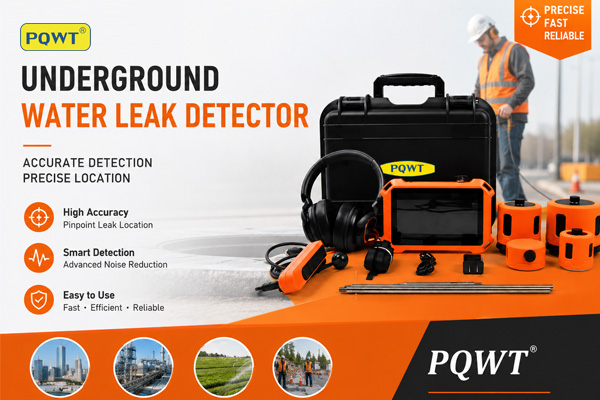
Modern underground pipe leak detector systems usually combine several technologies:
* Acoustic leak detection
Detects leak sound frequencies and helps technicians identify suspicious pipeline sections quickly.
* Correlation analysis
Uses dual sensors to calculate the leak position based on signal time differences for higher accuracy.
* Intelligent noise reduction
Advanced systems can filter environmental noise and improve leak detection performance in complex conditions.
Compared with traditional manual inspection, modern water pipeline leak detection equipment offers several advantages:
* No large-scale excavation required
* Faster inspection process
* Lower labor costs
* More accurate leak positioning
* Reduced water loss
This is especially important for aging water supply networks, industrial facilities, and agricultural irrigation systems where hidden leaks can become expensive operational issues.
Today, buyers are paying more attention to detection sensitivity, anti-interference capability, and smart data analysis when choosing a pipeline leak detector manufacturer.
PQWT leak detection solutions focuses on advanced underground leak detection technology for municipal projects, water utilities, factories, and rural water supply systems, helping users improve inspection efficiency and reduce maintenance costs.
For companies looking for reliable water leak detection equipment, investing in professional detection technology is often far more cost-effective than repeated pipeline repairs later.